
Auguste Mesnard was born November 17, 1875 in Cognac, France. He began his musical career as a violinist, studying at the Ecole Nationale de Musique d’Angoulème, and earning a first prize from there in 1891. After an unsuccessful audition to enter the Paris Conservatoire, one of his musical colleagues in Angoulème suggested that he take up the bassoon instead. He evidently took to the instrument right away, as he managed to gain entry to Eugène Bourdeau’s bassoon class at the Paris Conservatoire only two years later (November 1893). He won a first prize there in 1897, and went on to bassoon positions in the Concerts Rouge, Orchestra Lamoureux, and Societé Nationale de Musique. In his position as second bassoonist with the Orchestra Lamoureux, he played the premieres of Debussy’s Nocturnes and L’Après-midi d’un faune.
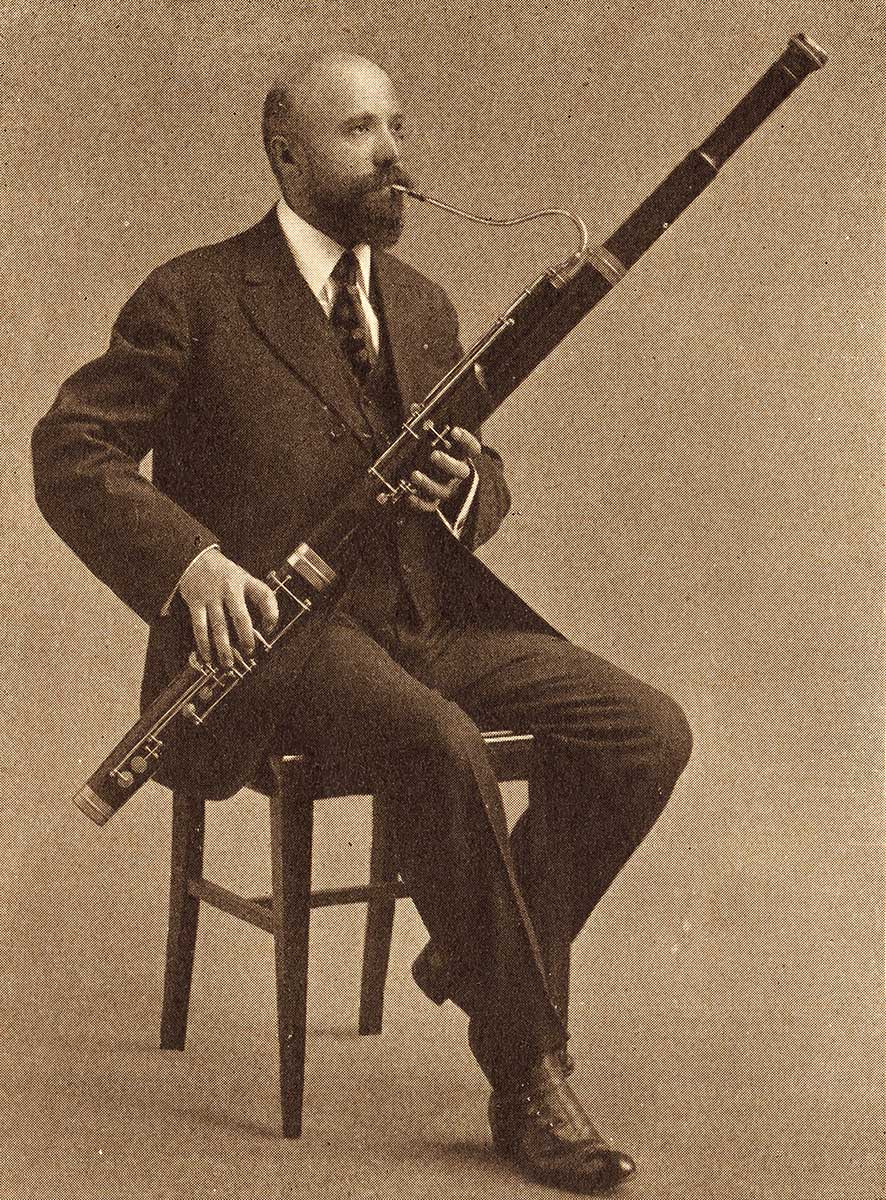
Auguste Mesnard, c. 1917, from Arthur Edward Johnstone's Instruments of the Modern Symphony Orchestra, page 32.
In 1905, Walter Damrosch, music director of the New York Symphony Orchestra, traveled to Paris in search of principal woodwind players for his orchestra. Mesnard auditioned for Damrosch and was hired, along with flutist George Barrère, oboist Marcel Tabuteau, and clarinetist Léon Leroy. Mesnard played under Damrosch for the the 1905-08 seasons, and then took a position with the Chicago-Philadelphia Grand Opera Company. In 1912 he turned down a job with Leopold Stokowski’s Philadelphia Orchestra, but soon returned to New York to join the New York Philharmonic under Josef Stránský. Willem Mengelberg succeeded Stránský in 1922, and did not get along with Mesnard. Mesnard’s colleague Benjamin Kohon related a possible reason:
Mesnard and I were associate 1st bassoonists with the N.Y. Philharmonic Orchestra for 2 seasons under W. Mengelberg, conductor. I imagine that Mengelberg did not like the French bassoon sound and thus was picking on Mesnard. They had an argument after a rehearsal and Mesnard resigned. And I would have done the same thing if I had been treated in a similar manner.1Benjamin Kohon, "Letter to the Editor," The Double Reed 2, 1 (1978).
Mesnard’s career continued for another 20+ years, playing with the touring Wagnerian Opera Company, the Capital Theater Orchestra under Eugene Ormandy, the Roxy Theater Orchestra, and an orchestra supported by the Works Progress Administration.2The Federal Music Project of the Works Progress Administration was responsible for the creation of 34 new orchestras around the country, and also supported a variety of other performance, educational, and scholarly activities related to music. Presumably, Mesnard was a member of the New York Civic Orchestra, but I haven't yet been able to confirm this. Mesnard retired in 1945 at the age of 70, and died in New York in October 1974, just shy of his 100th birthday.3United States Social Security Death Index, database, (FamilySearch, 20 May 2014), Auguste Mesnard, Oct 1974; citing U.S. Social Security Administration, Death Master File, database (Alexandria, Virginia: National Technical Information Service, ongoing).
Mesnard began writing his memoirs in 1943, shortly before his retirement, and worked on them over the next decade or so. These were never published, but copies of the typescript reside in the libraries of Southern Illinois University and the International Double Reed Society. I haven’t been able to examine this yet myself, but French bassoon specialist Laurence Ibisch wrote an article about Mesnard in the October 1978 issue of The Double Reed, with information taken from the memoirs.4Laurence Ibisch, "A French Bassoonist in the United States," The Double Reed 1, no. 2 (October 1978): 5-7. Unless otherwise noted, all the information in the preceding biographical sketch comes from Ibisch’s article.
Ibisch also owns and regularly plays on Mesnard’s Buffet bassoon — the very one in the photo above.5Laurence Ibisch, e-mail message to author, March 20, 2017. It was made in 1900, and has sixteen keys (rather than the 22 present on the Jancourt “perfected” system). Buffets are commonly made of rosewood, but this instrument has only a rosewood wing joint. The rest of the instrument is made of much lighter maple, which is more common for German bassoons.

Columbia A2161
During his tenure with the New York Philharmonic, Mesnard also worked worked as a recording artist for the Columbia Gramophone Company. Recording companies in that era generally didn’t credit individual orchestra members, so it’s probably impossible to know how many ensemble recordings he participated in. His one recording as a soloist was made on October 14, 1916—a duet with harpist Charles Schuetze. The piece they recorded, Serenade by Edmond Filippucci (1869–1948), is almost certainly an arrangement. Filippucci’s music is not easy to come by today either in printed or recorded forms, so I haven’t been able to identify the piece itself. But a likely candidate is his 2 Pièces pour violon avec accompagnement de piano: Nº 1. Sérénade, published in 1894.
Mesnard and Schuetze recorded four takes, the last of which was issued on Columbia A2161 in 1917 (backed with the Columbia Miniature Orchestra playing The Music Box).6Discography of American Historical Recordings, Columbia matrix 47068. Serenade / Auguste Mesnard ; Charles Schuetze, accessed March 19, 2017. This is from the era of acoustic recording (no microphones), and my copy of the disc has been well-used. So, the recording has a fair amount of background noise. But, it’s still quite enjoyable. Listen to Serenade here:
While you’re listening, read this short review of the recording, published in the Bridgeport (CT) Evening Farmer in March 1917:
An extraordinary Columbia recording is a woodwind (bassoon) and harp duet: Filipucci’s “Serenade,” played by Auguste Mesnard and Charles Schuetze, solo members of the New York Philharmonic Society. A zephyr-like harp introduction is followed by a lovely interweaving of beautiful inspiring notes. The light delicate voice of the harp over the deep undertones of the bassoon is indeed eloquent of evening—shimmer-moonbeams gleaming over the shadows of night. So far as is known, the “Serenade” is the only recording extant of a harp and bassoon duet.7"Talking Machine Records," Bridgeport Evening Farmer (Bridgeport, CT), Mar. 9, 1917.
Mesnard also recorded “The Elephant and the Fly” with flutist Marshall Lufsky in December 1916, but this was evidently never released.8Discography of American Historical Recordings, "Columbia matrix 47247. The Elephant and the Fly / Marshall P. Lufsky; Auguste Mesnard," accessed March 19, 2017. His colleague Benjamin Kohon recorded the same piece in 1918 for Edison Records. That version was released, and is available to stream from the UCSB Cylinder Audio Archive.
Notes:
- 1Benjamin Kohon, “Letter to the Editor,” The Double Reed 2, 1 (1978). ↩︎
- 2The Federal Music Project of the Works Progress Administration was responsible for the creation of 34 new orchestras around the country, and also supported a variety of other performance, educational, and scholarly activities related to music. Presumably, Mesnard was a member of the New York Civic Orchestra, but I haven’t yet been able to confirm this. ↩︎
- 3United States Social Security Death Index, database, (FamilySearch, 20 May 2014), Auguste Mesnard, Oct 1974; citing U.S. Social Security Administration, Death Master File, database (Alexandria, Virginia: National Technical Information Service, ongoing). ↩︎
- 4Laurence Ibisch, “A French Bassoonist in the United States,” The Double Reed 1, no. 2 (October 1978): 5–7. ↩︎
- 5Laurence Ibisch, e‑mail message to author, March 20, 2017. ↩︎
- 6Discography of American Historical Recordings, Columbia matrix 47068. Serenade / Auguste Mesnard ; Charles Schuetze, accessed March 19, 2017. ↩︎
- 7“Talking Machine Records,” Bridgeport Evening Farmer (Bridgeport, CT), Mar. 9, 1917. ↩︎
- 8Discography of American Historical Recordings, “Columbia matrix 47247. The Elephant and the Fly / Marshall P. Lufsky; Auguste Mesnard,” accessed March 19, 2017. ↩︎
3 Responses
Once again, an excellent post. Fine commentary and beautifully researched.
Thank you!
A Very Special Thank you for featuring my great Grandfather in this post! Thank you so much!!